
Preface
Hi all, welcome to my first book notes. I originally posted this article on my personal website several years ago and was recently inspired to re-post it (with minor edits). Also, I would like to attribute the majority or the organization/section labels to Ali Abdaal, from whom I took inspiration, including “Book in 3 sentences,” “Who should read it,” and “Top 3 quotes.”.
Why I’m writing about this book
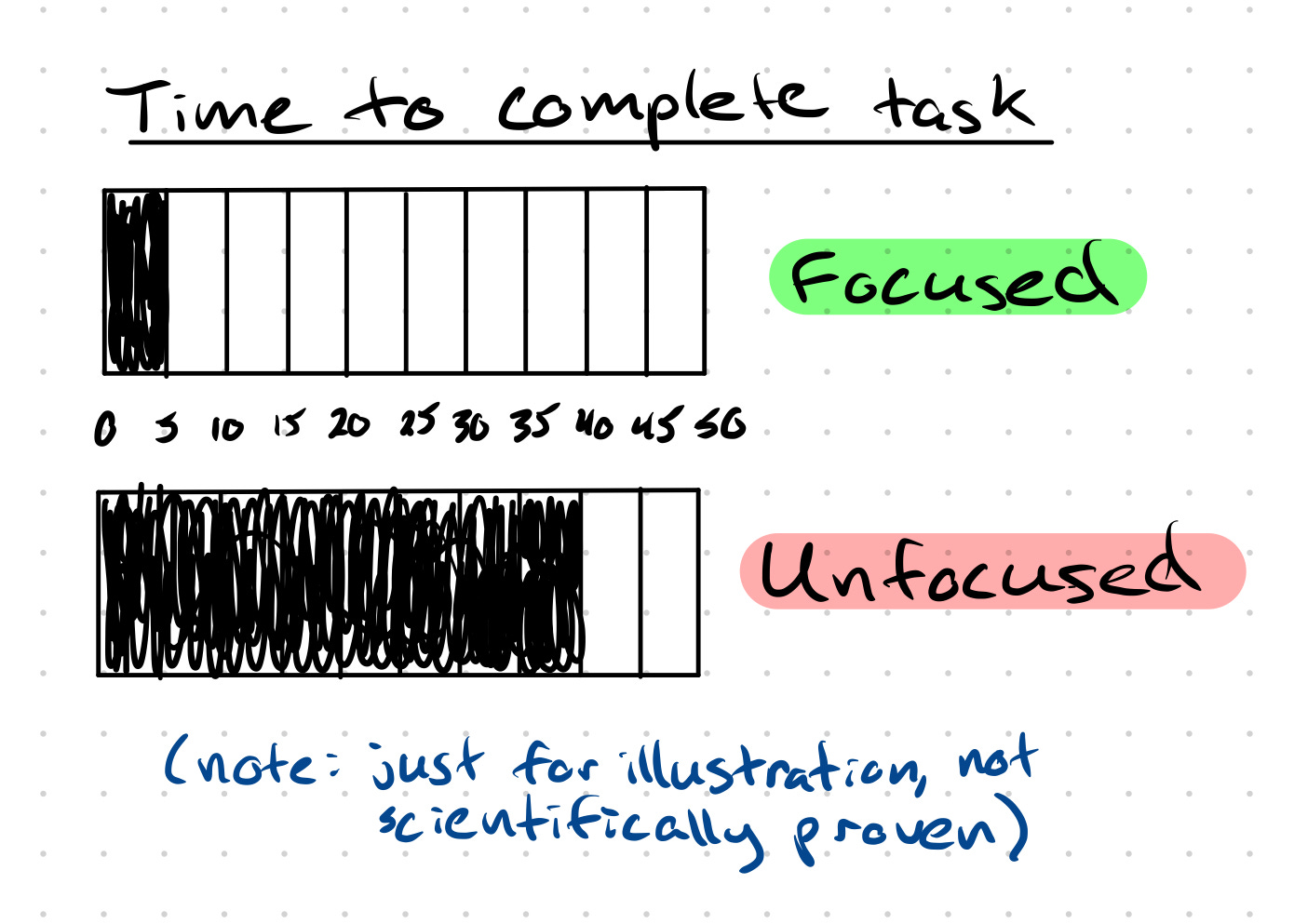
The core thesis of Deep Work is that productivity depends on both time and focus. While a seemingly trivial concept, it was impactful to me and helped me to restructure my approach to school/work, including some interesting optimizations, such as skipping class in favor of reading the textbook (note: I do not condone this).
Using these techniques, I started being able to complete all of my tasks and studying with time to spare, and I stopped stressing about being “busy” all the time. As a student and knowledge worker, the majority of my tasks require focus, and if I’m in a situation where I can’t provide that, I don’t waste the effort.
For example, if I’m hanging out with my friends, I’ve found that it’s not worth it for me to try to work on homework or projects at the same time. In my experience, this results in one of the following:
Best case, I completed 5-10 minutes worth of “focused work” and was only partially present with my friends.
Worst case, I got nothing done and was still only partially present with my friends.
How I discovered this book
I find it interesting to hear how people find media that impacts their lives, as it gives me a window into their process of discovery and the influences they had before they came across the piece. Here was my path:
Developed an interest in learning optimization.
Following this interest, I searched online for a book focused on action over theory and came across Ultralearning, which I bought and read.
While researching Ultralearning, I heard about the 4 Hour Work Week book, which I also bought and read.
After reading the 4 Hour Work Week, I became interested in Tim Ferriss and eventually listened to a blog he did with Cal Newport.
From there, I discovered Cal Newport’s book, Deep Learning, which targeted two of my major interests: using time efficiently and learning.
Book in 3 sentences
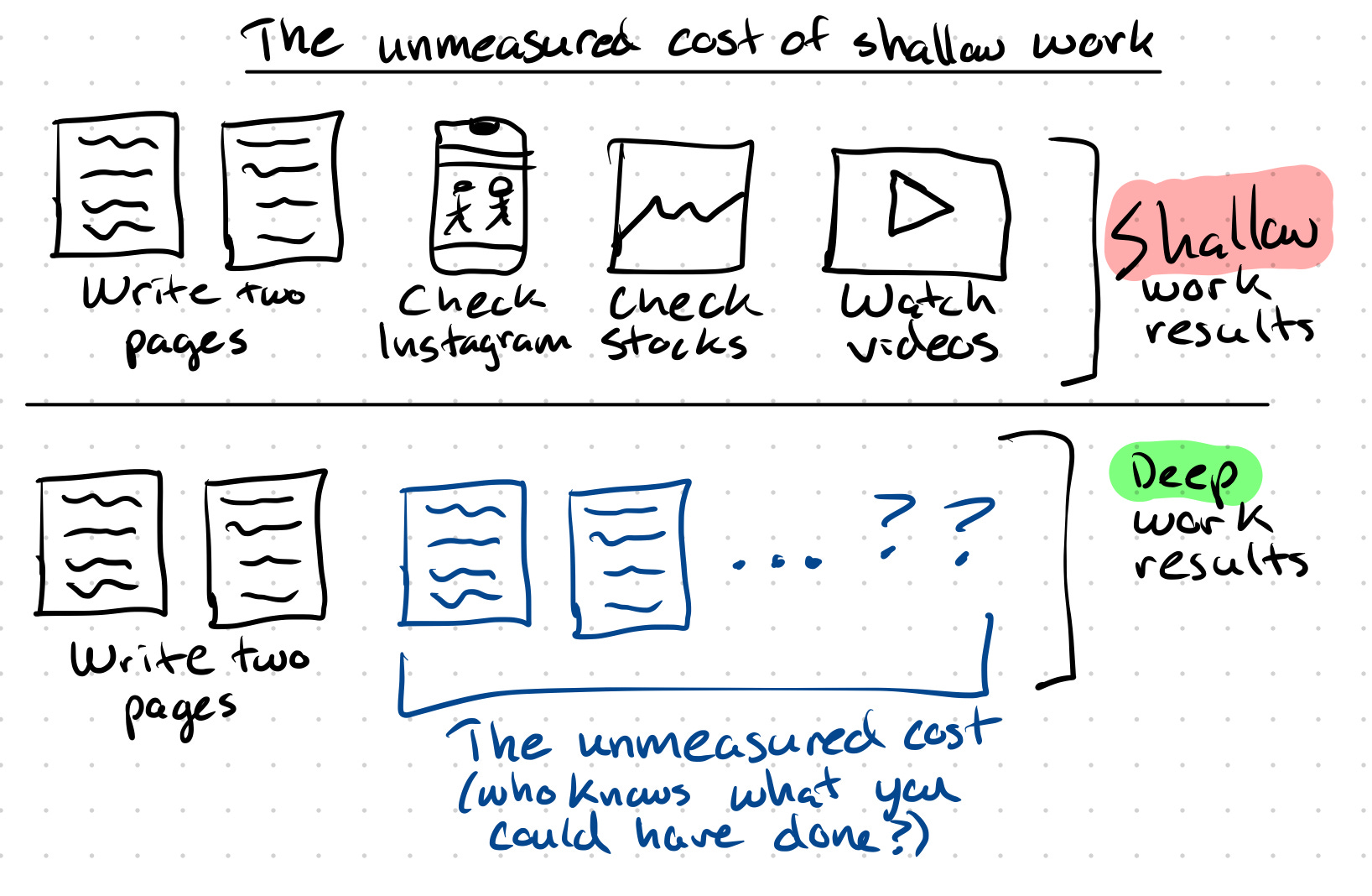
The value (amount/quality) of the work you complete is dependent on both the amount AND quality of time spent.
Preparing and completing deep work should be treated differently than shallow work.
Time box your work and completely separate when you’re done.
Who should read it
While this book is great for everyone, there are a few groups that might especially appreciate it:
Students, knowledge workers, and anyone else whose daily life requires learning, deep focus, or other similar effort.
Anyone interested in learning something new beyond their current daily life, such as a hobby or skill.
People who feel that they don’t have enough time for their tasks, even if those tasks aren’t something you might traditionally consider requiring “deep work.”
Top 3 quotes
“High Quality Work Produced = (Time Spent) x (Intensity of Focus)”
“Who you are, what you think, feel, and do, what you love—is the sum of what you focus on.”
“You have a finite amount of willpower that becomes depleted as you use it.”
Actionable takeaways
Replace distracted work sessions with single-task, highly focused deep work sessions that focus on your most important tasks.
Set up your deep work sessions intentionally. Set a time, place, and everything you need to support your work (ideas: coffee, snacks, water, a do not disturb sign, etc.).
Set an endpoint to your work, and complete a shutdown procedure when that time arrives. Determine what you did, what you didn’t do, and what you need to do next, then complete any tasks necessary to fully disconnect from work (e.g., check email/Slack/teams, update status documents, etc.).
Cameron’s personal recommendation — keep it simple and only add complexity if it is helpful. The majority of my deep work sessions take ~15 seconds of prep: turning my phone on do not disturb, then closing my door or putting on headphones (location-dependent).
Full summary and notes
This book is split into two parts. Part one details the ideas behind the concept of deep work, and part two provides rules for accomplishing it.
Part 1: Deep work is valuable, rare, and meaningful.
Newport begins the book with a claim there will be three distinct groups that will thrive in the future:
Those that are good at working with intelligent machines
Superstar performers in all fields
Owners of capital (or those with access to it)
He also claims that the first two groups can be joined directly through deep work, while the third group can be indirectly joined via deep work, yet many current trends in the world make deep work rare, including open plan offices, instant messaging, and social media. These increase the proportion of shallow work, which is unmeasured and is the difference between what a metric is and what it could have been.
In this section, Newport claims that deep work is meaningful from three separate perspectives:
Neurological — Time spent in a state of depth results in greater happiness and satisfaction in one’s working life.
Psychological — Deep work generates flow, which is directly proportionate to happiness (where flow is defined as a state where you lose track of time and produce high quality and creative work).
Philosophical — Deep work is like craftwork, as it imbues meaning and purpose with your outputs, regardless of the discipline.
Part 2: Four rules for deep work
Newport defines depth of work as approximately equal to the amount time it would take to train a college grad without relevant knowledge/experience to do the task. For example, it might take 10 minutes to teach a college grad how to clean dishes, whereas it might take several years (or decades) to teach a college grad how to design an airplane.
Under this framework, we can begin to classify our work and determine which of it most requires a specific deep work session. And once we’ve determined which of our work is deep, we can use the following four rules to produce deep work efficiently:
Rule 1: Work deeply
Newport details four primary time structures for completing deep work:
Monastic approach — 100% separation from world while working (e.g. isolate in cabin)
Bimodal approach — partial separation from world while working (e.g. months or weeks dedicated to work)
Rhythmic approach — fixed time for deep work during the day (e.g. 5AM – 7AM)
Journalistic approach — deep work whenever you can (e.g., one hour between meetings).
For the majority of us with “traditional” fixed schedules (e.g., school, full time job, etc.), approaches three and four are likely to be what will work for us. As a college student (at time of writing) and software developer, I almost exclusively rely on option four, scheduling my days as they happen.
Once you have your times set for deep work, Newport also recommends preparing your deep work ritual, which means preparing yourself for a deep work session. Similarly for how you’d prepare differently for a light jog than a marathon, he notes that deep work requires specific and intentional preparation. Here are a few useful things to consider:
Where you will work (office, coffeeshop, etc.)
How you’ll work (computer, notebook, etc.)
How you’ll support your work (coffee, snacks, etc.)
Once you’re engaged in your deep work session, he recommends you use the following techniques to continuously prioritize and optimize your work:
Focus on the important
Act on lead measures (e.g., number of pages written in a day is a lead measure of number of books written)
Keep a scoreboard — every time you complete a deep work block, make a tally on a calendar.
Create accountability — create personal rewards/punishments for yourself to incentivize deep work.
Finally, once you hit the end of your deep work session, Newport recommends completing a shutdown process and completely separating from your work. For example, here’s a sample simple shutdown process based off the one I use:
Log work completed.
Note any missed items.
Review communication channels (email/Slack/etc.)
Rule 2: Embrace boredom
In this section, Newport dives into the boredom and its utility in deep work.
Set focus breaks by setting a timer/specific endpoint when you work.
Regulate your internet usage (or if your work requires the internet, limit the amount of non-work related internet you can consume).
Use “Roosevelt dashes,” which are artificially shortened deadlines to increase the intensity of your work.
Meditate productively 2-3x/week (e.g., pause your work on a long-term hard problem and take a walk).
The last one is fairly interesting, and it’s a technique I recently started incorporating into my work. Contrary to Newport’s recommendation, I primarily use it after I complete a given task. For example, after I complete a “unit of work” (e.g., document, code block, section of project), I’ll take a walk before moving on. During/after these walks, I’ll often find an improvement or catch a mistake that I may have missed otherwise. In extreme cases or for large projects, I’ll even sleep on it and re-review the next day, providing my subconscious time to think about the problem.
Rule 3: Quit social media
Newport’s generally advice here is to adopt networking tools (I.e., social media) only if their positive impact substantially outweighs their negative impact.
Personally, the benefit of social media outweighs the negative impact, so I’ve maintained fairly reasonable levels of social media. As someone whose friends are scattered all over the country (and world), I enjoy keeping up with them and sharing what I’ve been up to.
Rule 4: Drain the shallows
This section provides a few more tips on removing shallow work from your typical days:
Schedule your day using time blocking
Make an hourly schedule with each hour taken up by something
If a task is of uncertain length, add some padding to the back
Use fixed-schedule productivity by not working beyond a certain time
Email with intention to end conversations
For example, don’t ask when someone is available to meet. Send them three options of when you are and ask them to pick one.
Closing
Thanks for reading my first post! If you enjoyed, feel free to subscribe, and I’ll let you know when I post the next one. And if this post was impactful to you or you would otherwise like to get in touch, please feel free to send me an email at hi@cameronanundson.com.